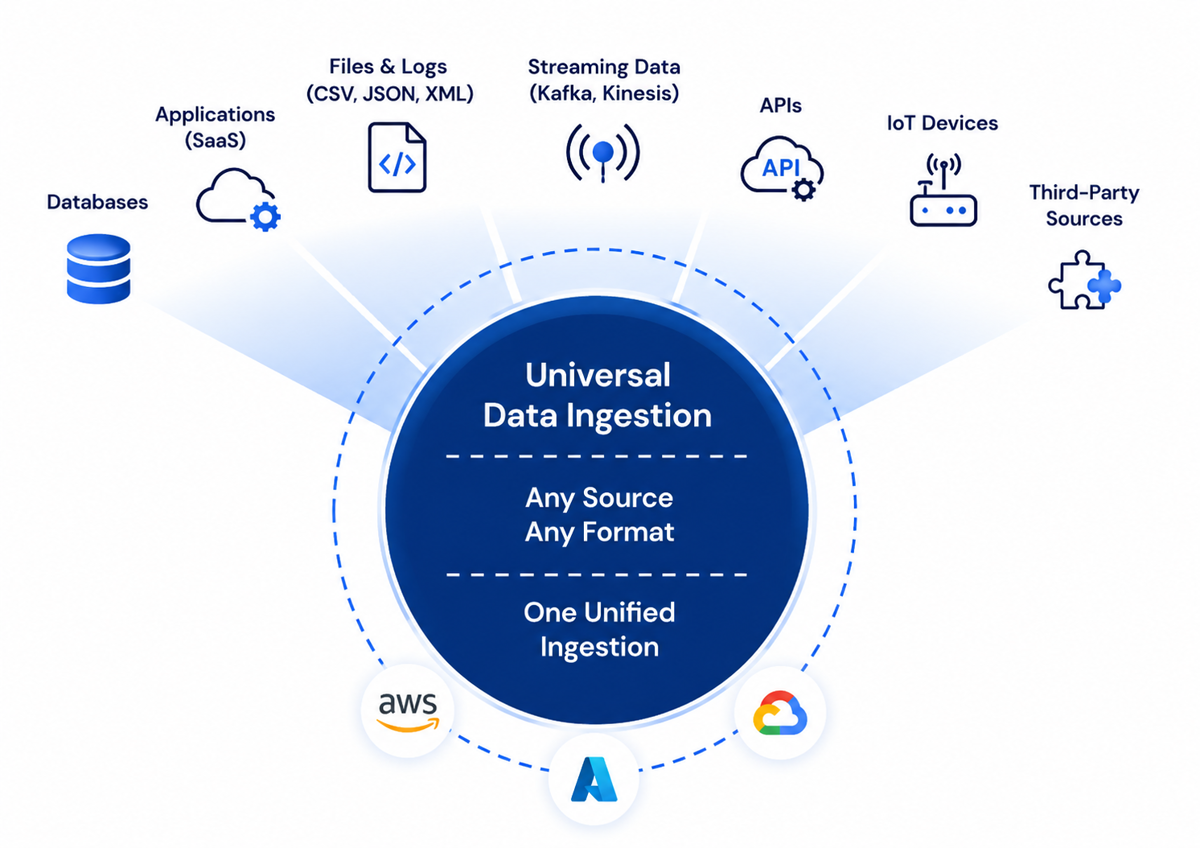
How It Works (Architecture)
-
Data Collection
Receives data from APIs, streams, IoT, and files using a proxy agent or ingestion API in any format.
-
Buffering & Staging
Holds incoming data in a staging layer like Kafka to absorb spikes and decouple producers from consumers.
-
Enrichment & Transformation
Validates schemas, inserts timestamps, normalizes fields, and applies business rules to data in-flight.
-
Velocity-Aware Routing
Routes transformed data to the right destination lake, warehouse, or OLAP at each target's speed.
-
Delivery & Monitoring
Lands data in the target store and tracks throughput, quality, errors, and pipeline health in real time.
Key Capabilities
-
Format Agnostic
Accepts data from any source in structured, semi-structured, or unstructured formats without prior conversion.
-
Dual Ingestion Modes
Supports both push and pull mechanisms to stay compatible with virtually any producer or source system.
-
Real-Time & Batch Support
Handles streaming and scheduled batch processing within one pipeline, removing the need for separate systems.
-
Data Enrichment & Transformation
Enriches raw data in-flight by normalizing fields, adding timestamps, and applying rules without extra ETL.
-
Centralized Monitoring
Tracks pipeline health, data quality, throughput, and errors across all sources from a single unified view.